 A young man came to me in my office, fearful about getting engaged. Several of his friends had been telling him what hard work marriage is, to the point that he was questioning if it was even worth the effort.
Having just celebrated 40 years being married to Cindy, I assured him that marriage can be well worth the work required. And I surprised him by explaining that marriage is a lot like waterskiing. Let me tell you what I mean by that.
When I was a kid, I learned how to waterski at Lake Ripley, Wisconsin. My good friends, the Ericksons, had a boat, and during the summertime, they often invited me to join them. It was an adventure that I grew to love! Yes, it takes work, but when you get it figured out, it’s so delightful that you don’t even think about the work it takes.
How to ski.
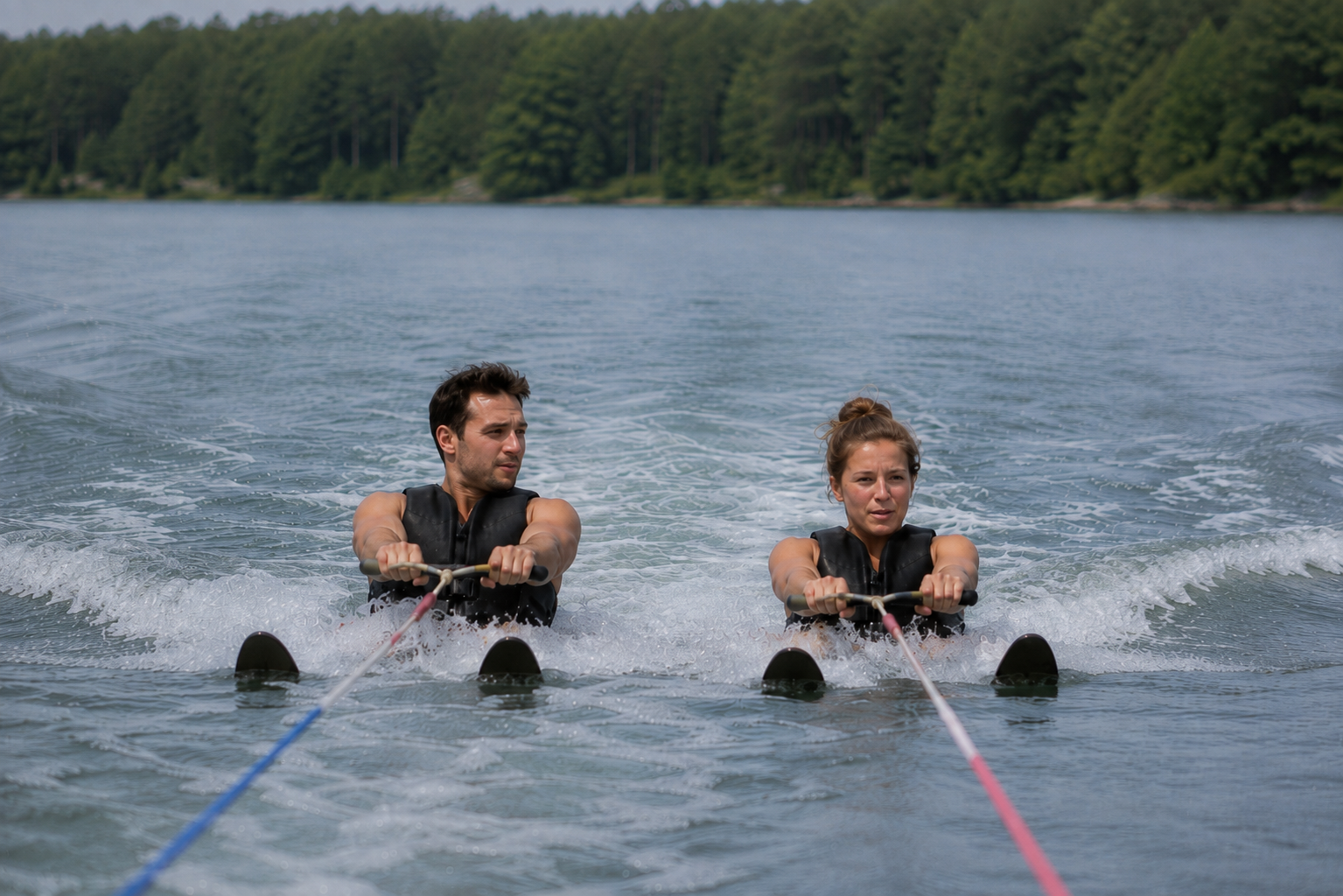
When you first start out, you find yourself bobbing in the water with four initial tasks: 1. squeeze your feet into the tight rubber ski bindings, 2. grab the rope handle, 3. paddle your your body around so you are eventually facing the boat, and 4. raise your submerged ski tips to the surface and position them on each side the rope.
At the other end of the rope, of course, is the boat, which begins trolling forward until the rope tightens. That’s the moment where your arm strength is suddenly tested–you must grip the tow rope tightly while it lunges you forward through swirling water that is surprisingly heavy. If your grip slips, the rope springs forward while you plunge backward. It’s embarrassing when the boat must circle back, snagging you with the rope as it passes around you for your next attempt.
You try again and you hang on for life, and eventually you don’t lose your grip! Then, all of a sudden, the boat goes full-throttle! Not only must you grip the rope even harder, but now you must provide the correct amount of resistance between the rope and your skis, using the entire core of your body. Too little resistance propels you forward over your skis, causing you to face-plant into the water. Too much resistance throws you down on your back, ensuring a noseful of water. The trick is adjusting your resistance according to the speed of the boat. Giving up is tempting. For me it took many dropped ropes, face-plants, and noses full of water before I finally learned how not to crash at startup! (You can see that skiing takes a lot of effort even before you start to ski!)
And then comes the surprising part. As your speed increases, there comes a point where you literally pop up out of the water and find yourself on top of it rather than being dragged through it. 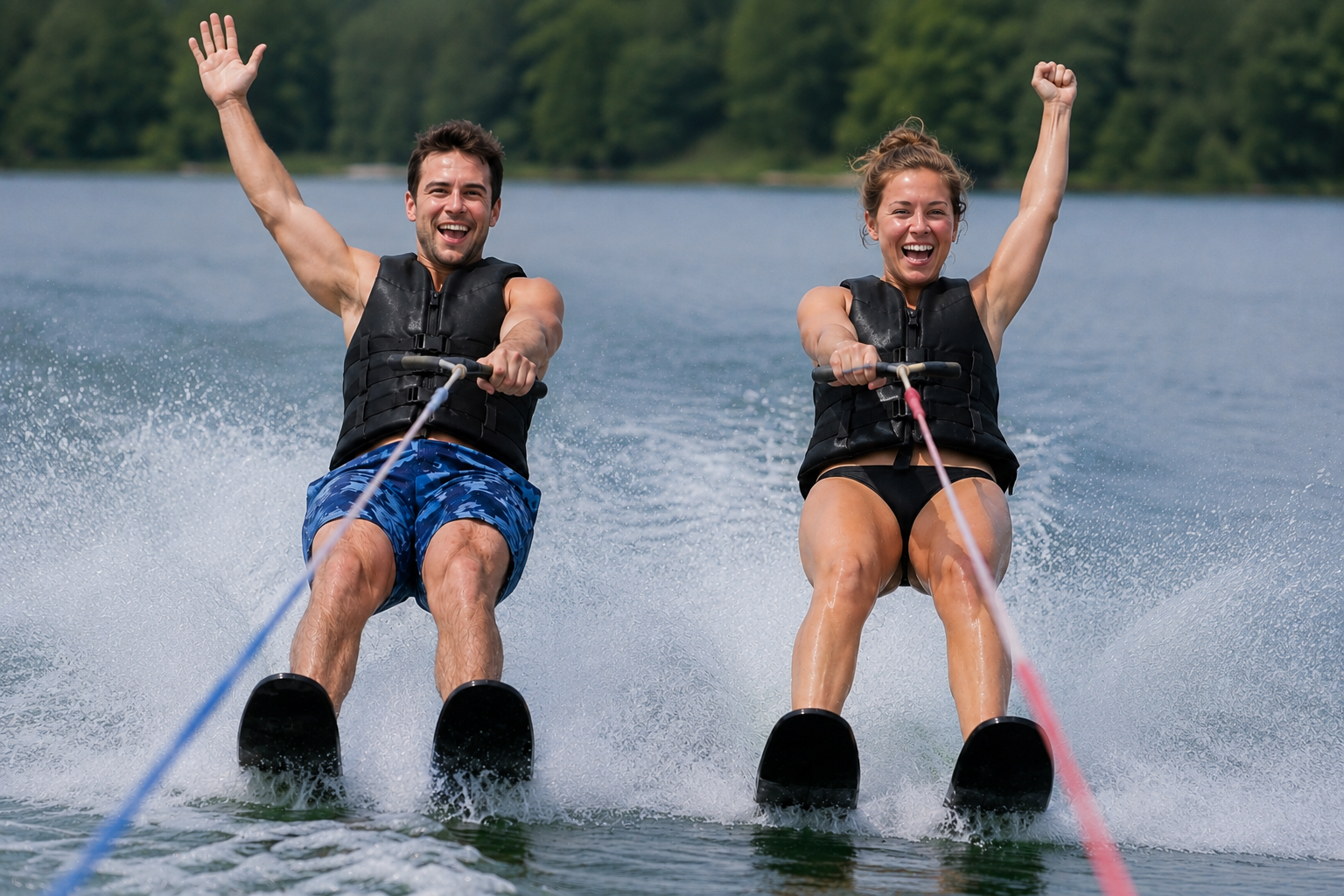 Your skis, which had felt so heavy being dragged through the water, now feel weightless, hydroplaning effortlessly on the water’s surface. From this point on, it takes very little energy to keep yourself upright–in fact, you can now hold the rope with just one finger!
Instantly, the ride is exhilarating and the work seems minimal.
That’s exactly how I see healthy marriages.
Marriage takes a lot of work at first because there’s a big learning curve.
- We have to shift from a “me” mentality to a “we” mentality.
- We are forced to share–and as we learned in Kindergarten, sharing is hard!
- This sharing involves our whole person and includes every element: time, space, and matter.
- Where we differ, we must either defer, meet in the middle, or compromise.
- We have to learn another language, i.e. love.
- On those occasions when we fail to love we must be quick to apologize and forgive.
- We have to learn to share concerns honestly, but constructively.
- We have to accept unfairness and love unconditionally.
[Of course, it will take a lifetime to fully master all these things, but I believe that making even small efforts toward those goals will quickly “pop” your marriage up on top of the water.]
Once we get up to speed, Marriage is exhilarating and takes relatively little effort.
- When you are convinced your spouse is “for” you, not “against” you will naturally give the benefit of the doubt.
- When we feel genuinely loved in meaningful ways, it’s easy to want to love back.
- When wounds are healed quickly, resentment never has time to creep in.
- When respect is shown, it’s easier to show respect.
- Where trust is unquestionably felt, intimacy is the natural result.
- The absence of negative energy (fear, resentment, suspicion, neglect, and avoidance) builds up, rather than tears down.
- Freedom and generosity flow freely.
Now I realize that a good number of marriages do not function as I’ve described above. Such marriages don’t seem like Waterskiing at all, but more like a constant struggle to keep one’s head above water. In my next post, I’ll talk about that, thinking about what obstacles might prevent marital enjoyment and what may be done about it.








 In my last post, on

 You’ll note that for the first year or so, it seems the parent has zero control — indeed the child controls the parents! The baby cries: the parent feeds him. The child poops: and the parent rushes to change the diaper! Like it or not, that’s how it works!